
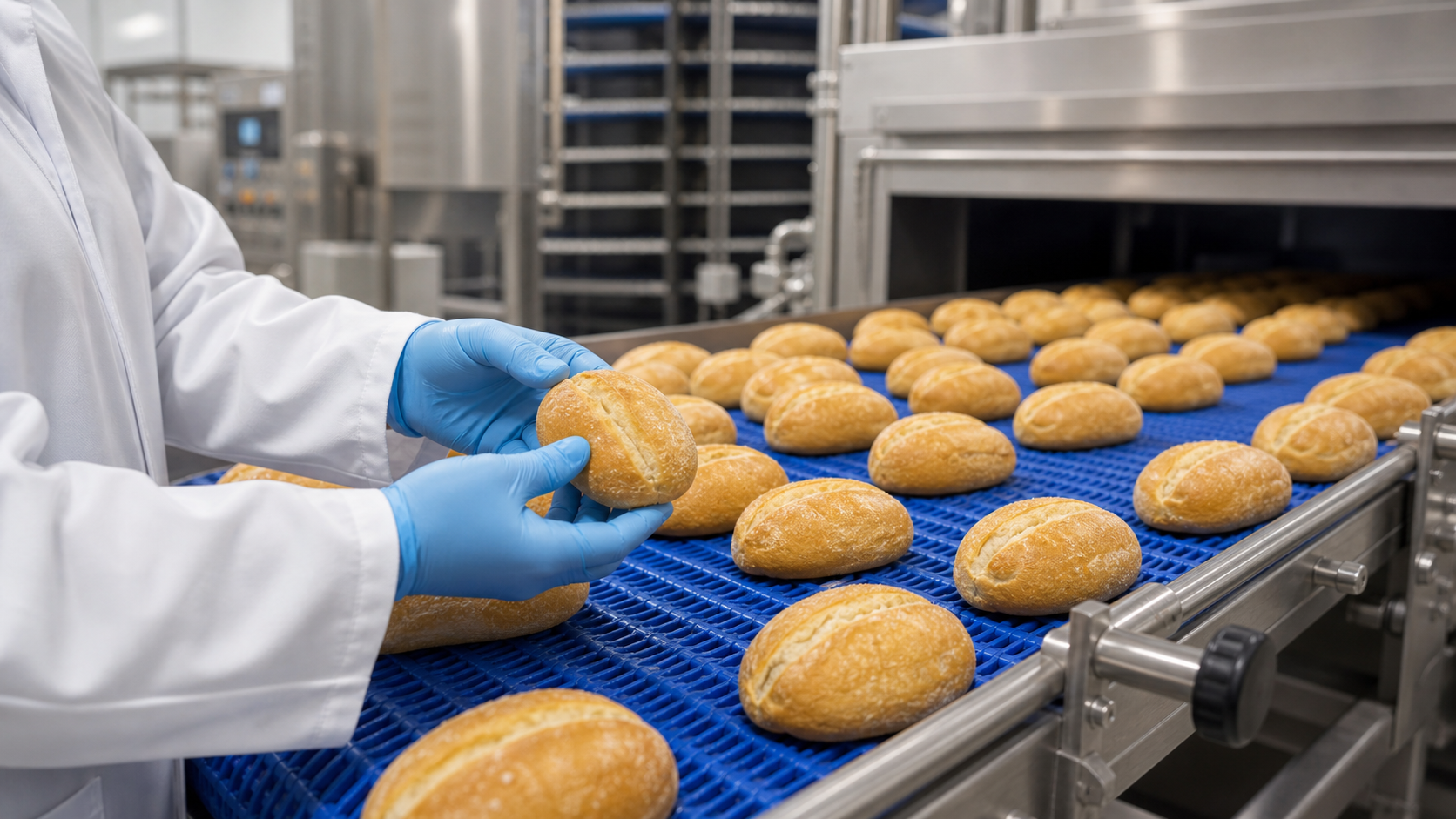
Fryer Line: High-Capacity Food Processing
Custom configuration. Commissioned 2023–2025. Reference performance data available.
Square’s continuous immersion fryer efficiently fries various meat products, employing a centrifugal pump to circulate cooking oil from outfeed to infeed.
Precise PID control maintains cooking oil temperature within +/-1℃, heating it via a thermal oil-operated tube heat exchanger.
Products progress from a feeding conveyor to a Teflon belt, forming a crust, and finish frying on a stainless steel belt. A scraper conveyor continuously removes sediment and residues.
Customized to client specifications
Capacity ranges from 1 to 3.6 tons/hr
Efficient and precise control of temperature and speed
Multiple slag scraping technique
Hygienic design
Patented Teflon belt
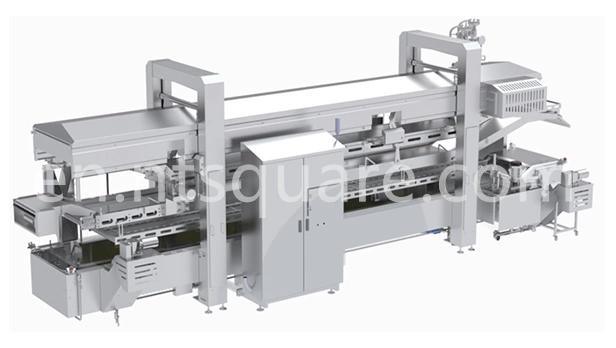
Product Features
Explore the original product feature overview, including Product Conveying System, Internal Oil Circulation, Lateral Sediment Scraper(Optional), and the key technical advantages behind this system.
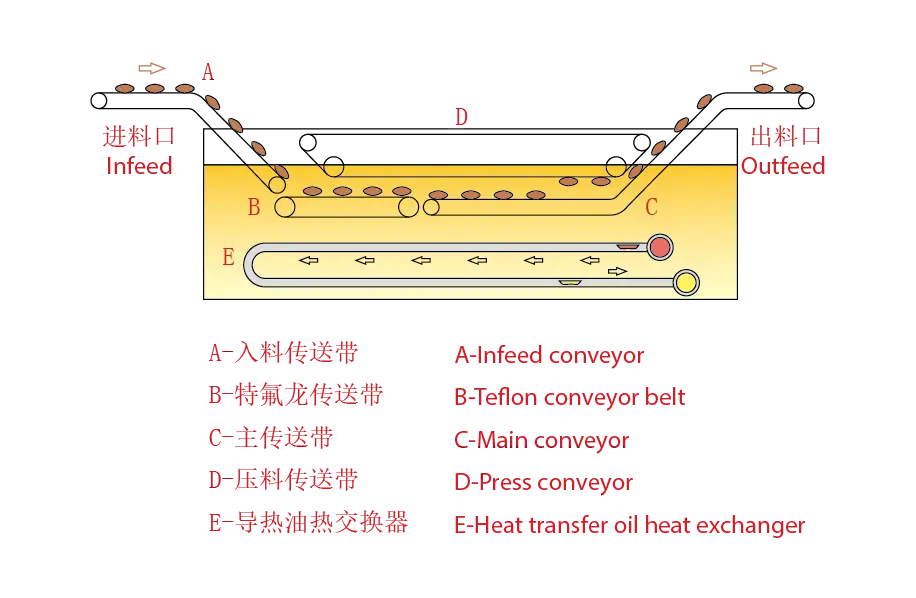
The direction of the products is the same as cooking oil, which ensures that the products are arranged in order.
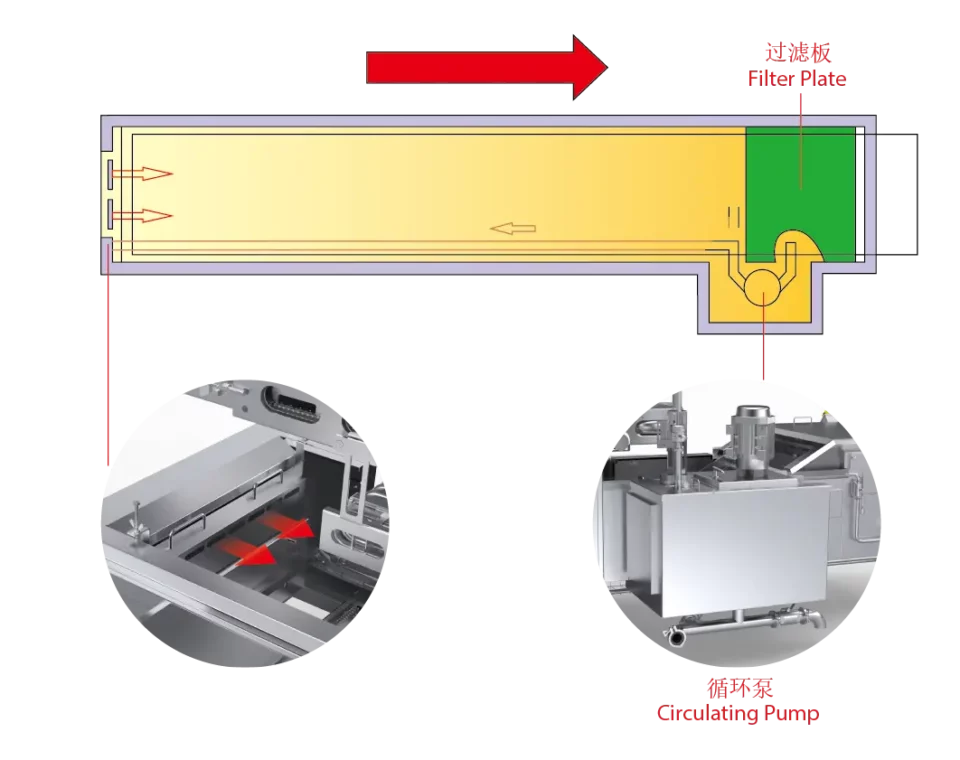
The direction of the product flow is the same as the cooking oil flow, which ensures that the products are arranged in order.
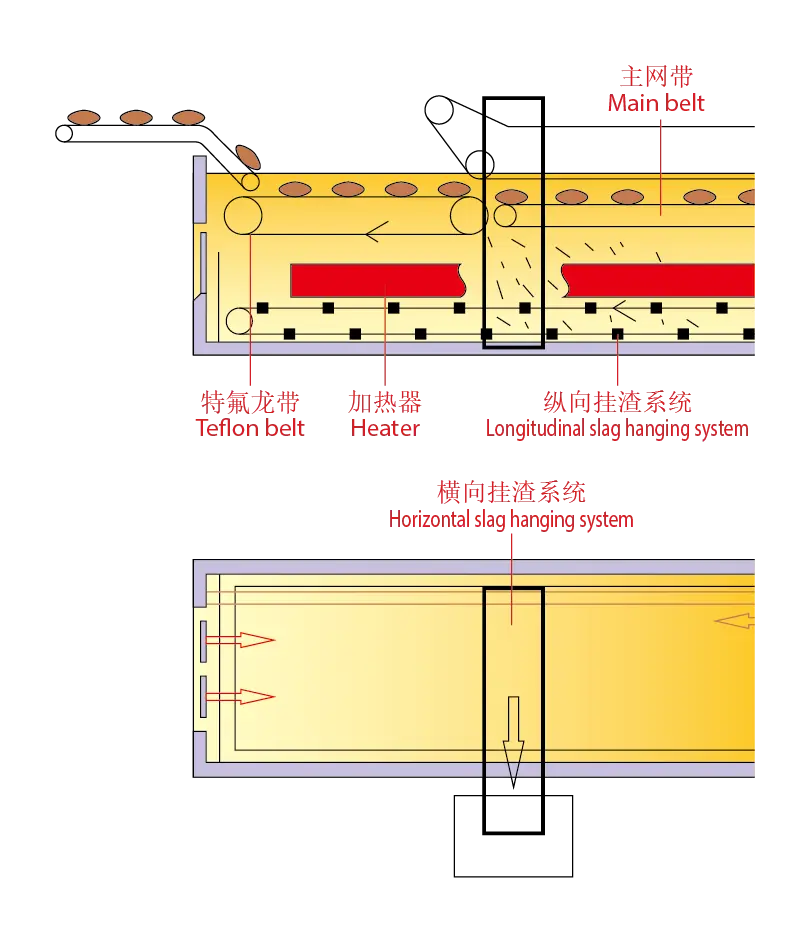
For fryer with Teflon belts, the lateral sediment scraper is positioned in the middle of the fryer between the main belt and the Teflon belt.
The lateral sediment scraper removes the sediments from the bottom of the fryer before the longitudinal scraper and keeps the oil clean.
The horizontal slag scraping system brings the slag falling on the bottom out of the fryer prior to the vertical slag scraping system, which reduces the residence time of the slag in the fryer and relieves the burden of the vertical slag scraping system.
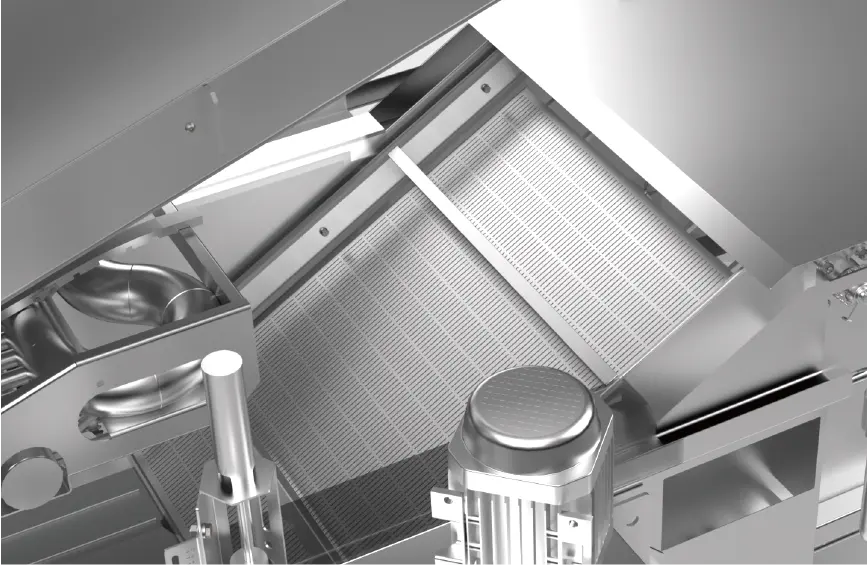
Filter mesh fineness up to 400 microns. The scraper removes the slags that are filtered by the stainless steel mesh out of the fryer. The conveyor belt carries the slag to the tray.
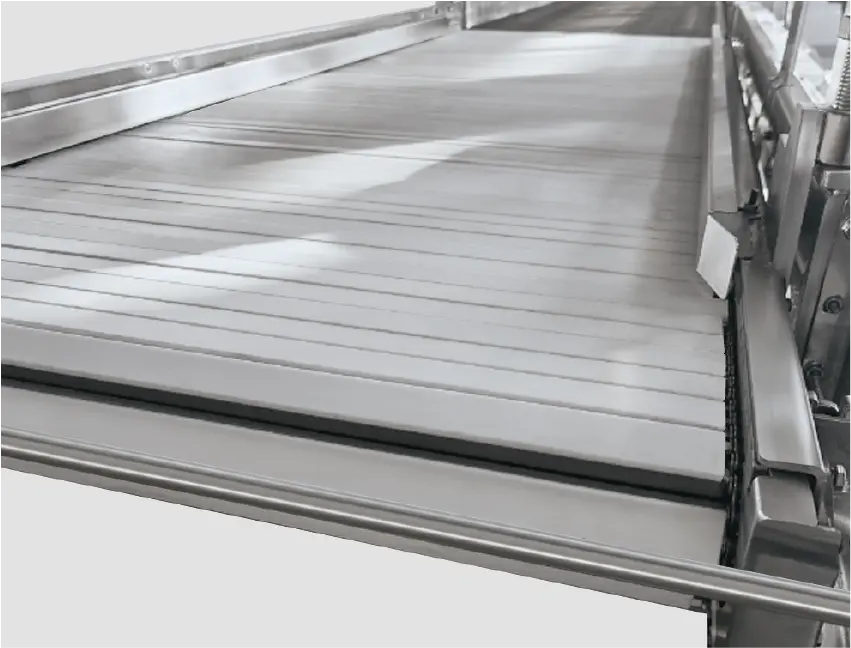
The Teflon belt is chain-driven and durable. The individual Teflon modules can be replaced quickly without replacing the whole belt.
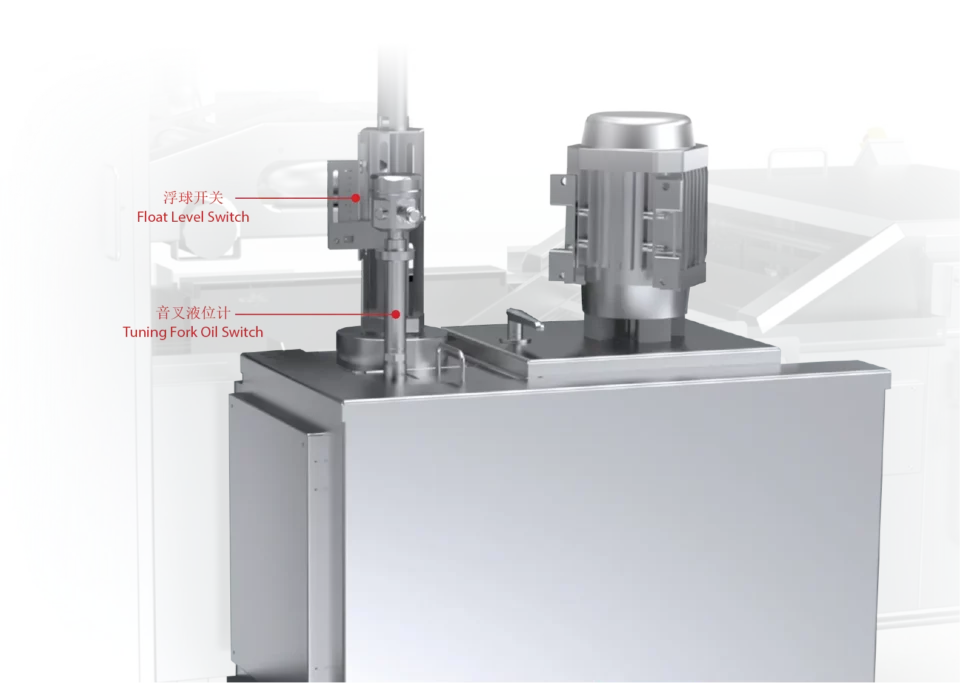
Float level switch: when the actual oil level is lower than the set oil level, new oil will be filled to the oil tank until the set oil level is reached. Tuning fork oil level switch: ensures that the heater is always immersed in the oil. The oil can only be heated when the heater is below the oil surface.
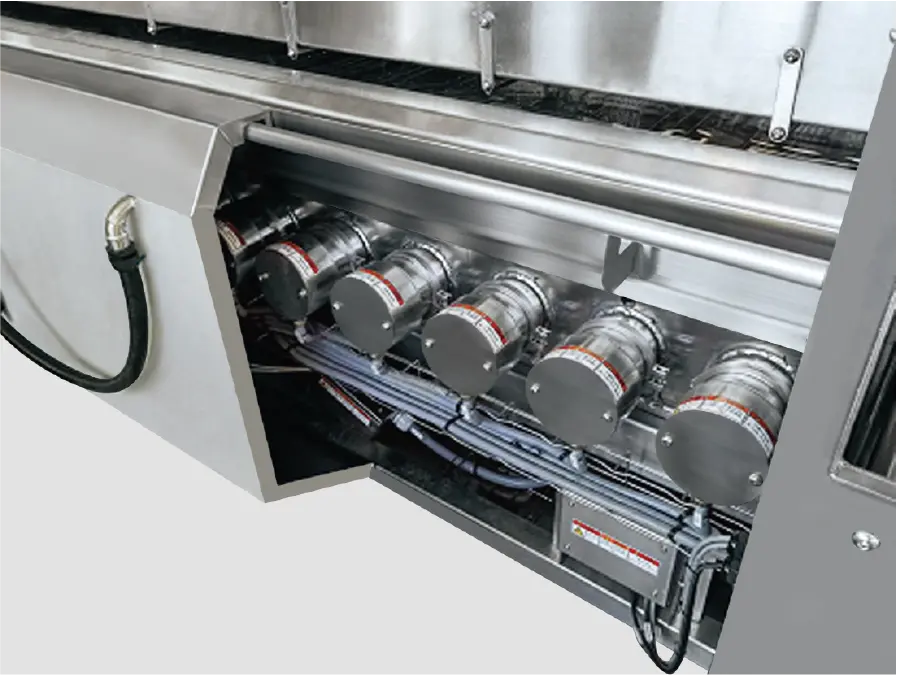
PID for precise temperature control. Advanced solid-state relays are used to enhance the reliability and durability of electrical components Multiple heating elements are placed laterally along the fryer. Heating elements are easy to install or remove. Large heat exchange surface of the heating rod. The heating rod is open enough to allow the sediment to fall on the sediment scraper below.
Technical Specifications
Two structural configurations available: double spiral freezer and single drum spiral freezer. Custom dimensions and capacities upon request.
| Configuration | Continuous submerged belt fryer — straight-line configuration |
|---|---|
| Belt width | 600 – 1,500 mm |
| Oil volume | 1,500 – 8,000 liters (product-dependent) |
| Temperature range | Ambient – 200°C |
| Heating method | Thermal oil / Gas-fired tube / Electric immersion |
| Heating zones | 2 – 4 independent zones |
| Filtration | Continuous dual-filter with auto-changeover, 50–100 μm mesh |
| Sediment removal | Conveyorized bottom scraper, programmable interval 15–30 min |
| Hood & exhaust | Full-length extraction hood, variable-speed exhaust, optional emissions treatment |
| Oil storage | Integrated heated storage tank, 2x fryer volume, rapid transfer pump |
| Control system | PLC touchscreen, recipe storage, oil quality monitoring, VPN remote access |
| Typical lead time | 14–18 weeks (custom configuration) |
| Design life | 15+ years (structural); 6–8 years (belt & heating elements, normal operation) |
Design Details
Expand any section below for the engineering approach behind each critical subsystem — with links to detailed Technology pages.
Oil is heated by a multi-pass shell-and-tube heat exchanger (thermal oil system) or direct-fired tube bundles (gas system). Multiple temperature zones along the fryer length enable a stepped temperature profile:
Oil quality directly affects product taste, color, and shelf life. The continuous filtration system removes:
Oil turnover rate (fresh oil addition per kg product) is calculated during design to maintain FFA below target thresholds for your product specification.
Products enter via infeed conveyor and are gently transferred to the submerged belt. Key design elements:
Frying generates water vapor, oil mist, and volatile organic compounds. The exhaust system includes:
End-of-shift or between-product cleaning:
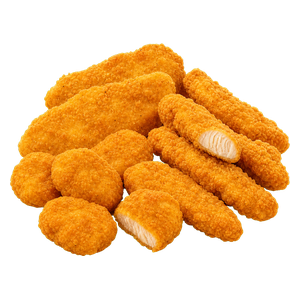
Coated Poultry
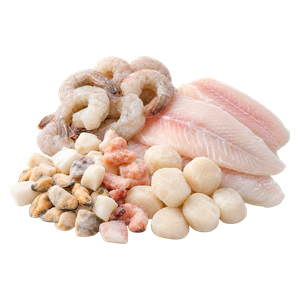
Seafood Products
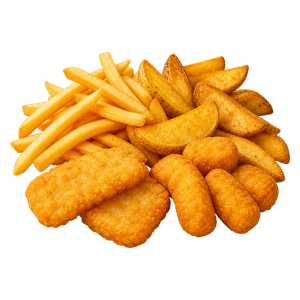
Potato & Snack Products
Prepared Foods
Pastry & Doughnuts
Multiple systems keep the oil clean:
● Lateral sediment scraper (optional) removes sediment before the longitudinal scraper
● Horizontal slag scraper reduces residue retention time
● 400-micron filter mesh removes fine particles
● Scraper conveyor continuously removes residue from the fryer bottom
Square continuous fryer uses PID control system to keep oil temperature within ±1°C, ensuring consistent product quality. Heat is provided by a thermal oil-operated tube heat exchanger or optional electric heating system.
We own CE, EAC, INF, CNAS, ISO, ASME, PED, U2, CSA, CRN certifications and 300+ patents, as well as 350+ engineers. Square vertically integrated production ensures quality control from raw materials.
Square offers customized one-stop cold chain solution that meets your requirements. Square designs each fryer to client specifications, offering multiple options for belt width (600mm, 800mm, 1000mm), frying length (6m, 8m, 10m), and customizable capacities ranging from 1 to 3.6 tons per hour. Additional features like sediment scrapers and heating type can be tailored.
Yes. Square also offers electrically heated continuous fryers with:
● Multiple lateral heating elements
● Advanced solid-state relays
● Large heat exchange surface
● Easy maintenance and sediment-friendly layout
Case Studies
Real production lines with performance data — not renderings, not claims. Each installation documented with commissioning data.
Custom configuration. Commissioned 2023–2025. Reference performance data available.
Energy-efficient configuration. Full production data available upon request.
Engineering Inquiry
The more detail you provide, the more precise our engineering response. An engineer — not a sales representative — will review your requirements.