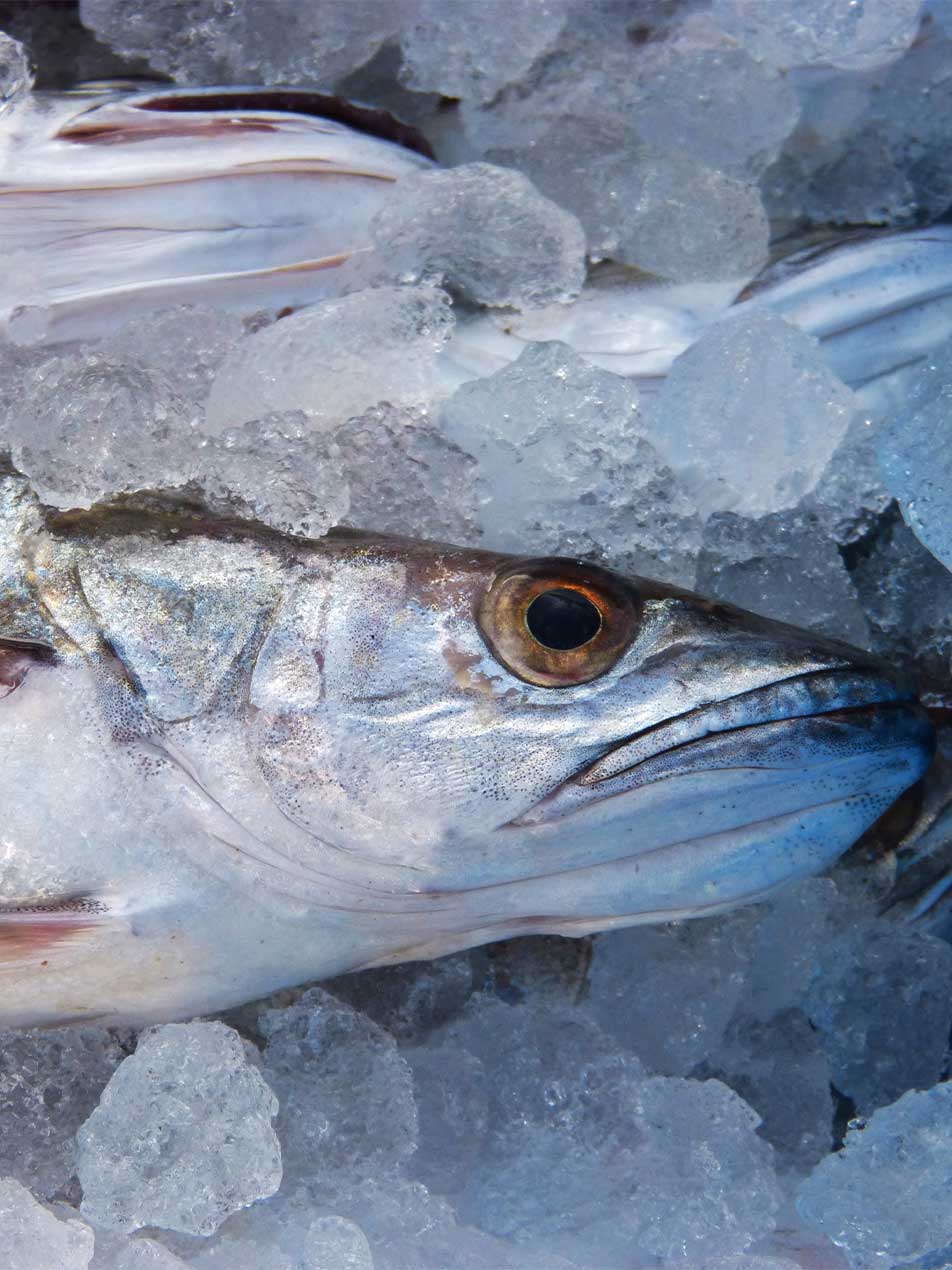
Seafood
Contact freezing is suitable for fish, shrimp, surimi and other seafood formed into dense blocks.

Square’s plate freezer is suitable for frozen blocks, such as fish, shrimp, surimi, meat, pet food, juice, etc. Our Plate freezers are commonly used for freezing brick-shaped products in mold or boxes. In plate freezers, refrigerant is allowed to circulate inside thin channels within the plates.
The packaged products are firmly pressed between the plates. High rates of heat transfer can be obtained between the packaged product and the evaporating plates. We are proud to be the drafter of the China National Standard of Plate Freezer (GB / T22734-2008).
Unique one-piece insulated enclosure with better insulation and strength.
Full stainless steel structure with good appearance, easy to clean.
Aluminum-alloy evaporative plate with better freezing capacity.
Separate liquid supply and suction for each plate, even supply with high efficiency and better freezing performance.
Mass production, freeze in blocks.
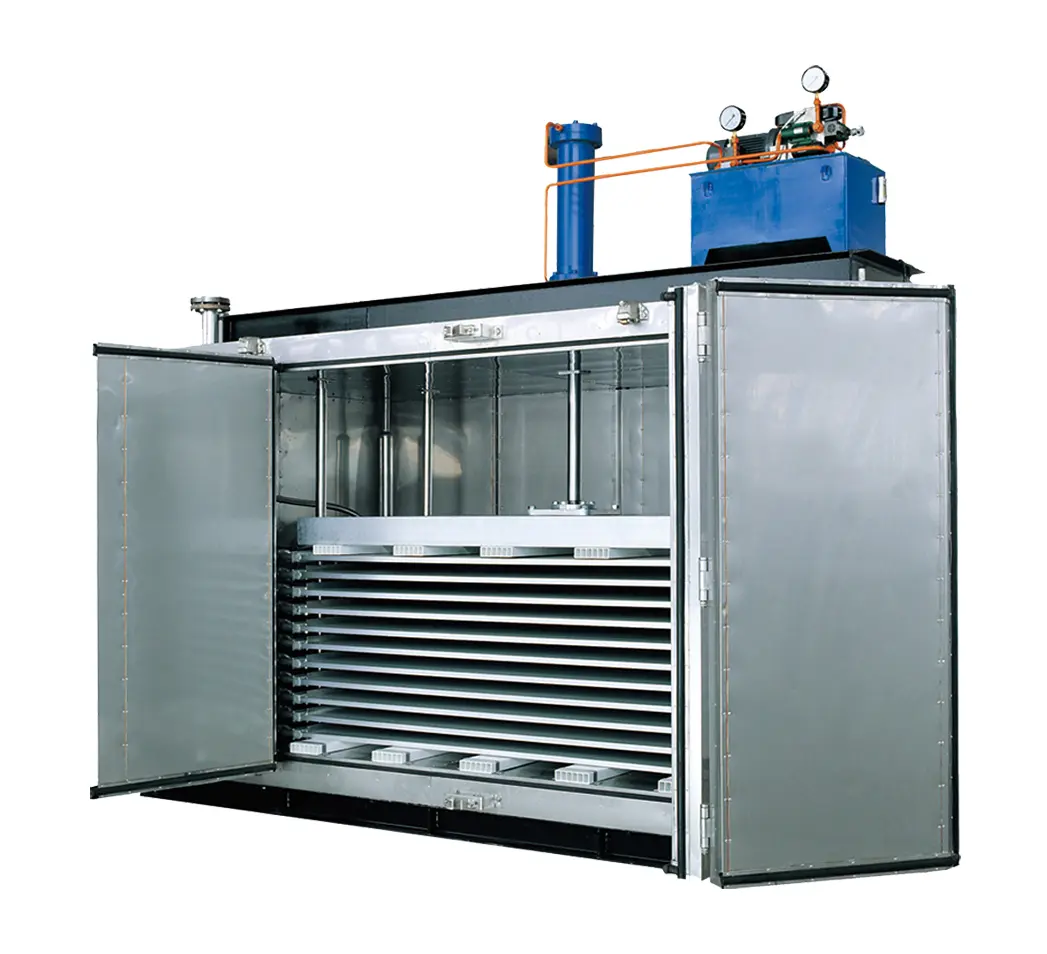
Product Features
Explore the key product features, including High Efficiency, Good Insulation Performance&Easy To Clean, and the engineering advantages behind this system.
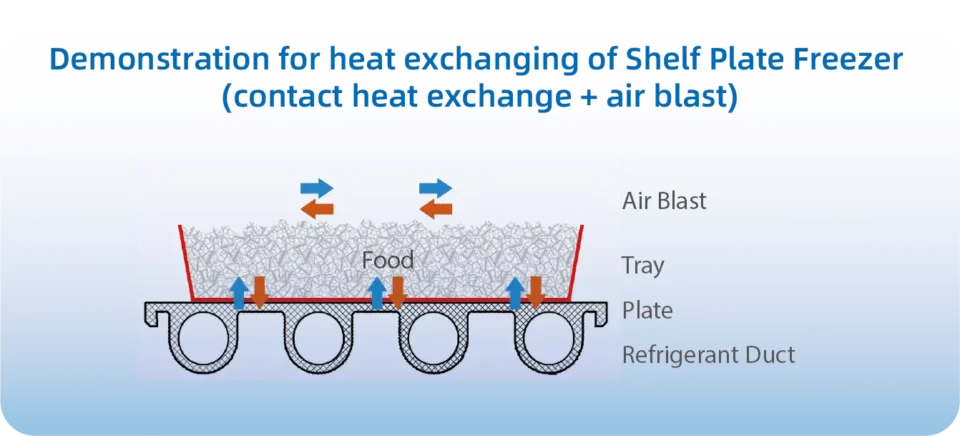
Made out of seawater-resistant aluminum, food grade, the 25mm thick Square aluminum plate gives high strength, high corrosion resistance, and thermal conductivity. Our plate is automatically welded and has minimum deformation.
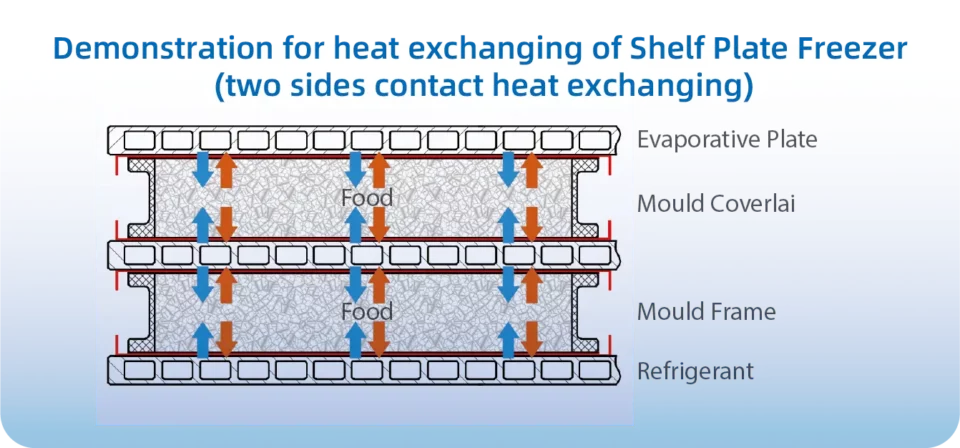
The enclosure is insulated with one piece of Polyurethane foaming to ensure a robust structure and minimize the cold loss by eliminating the joints. Our plate freezer’s enclosure is stainless steel. It can sustain the harsh marine environment and is easy to clean.
Technical Specifications
Plate freezer parameters cover plate dimensions, plate spacing, freezing capacity, refrigerant, hydraulic operation, enclosure, loading arrangement, and controls for block or packaged products.
| Configuration | Horizontal (cartons/trays) or Vertical (bulk blocks/marine) |
|---|---|
| Plate material | Aluminum (standard) / Stainless steel (optional) |
| Plate dimensions | Custom per product size — typically 1,200–2,400 mm × 600–1,200 mm |
| Number of plates | 5 – 20+ per station |
| Plate gap | 25 – 150 mm (adjustable per product) |
| Refrigerant | NH₃ (Ammonia) / Brine / CO₂ / Freon |
| Plate temperature | −40°C to −25°C (design) |
| Hydraulic system | Electric hydraulic pump, controlled pressure 80–150 bar |
| Freeze cycle | 2–6 hours (product-dependent) |
| Control system | PLC with HMI, programmable recipes, data logging |
| Typical lead time | 12–16 weeks |
| Design life | 20+ years (structural); 15+ years (plates, normal operation) |
Design Details
Expand any section below for the engineering approach behind each critical subsystem — with links to detailed Technology pages.
Plate freezers use conduction — direct contact between refrigerated plates and product surfaces. Air-blast freezers use convection — cold air blown over product. The thermal conductivity difference is dramatic: aluminum (~200 W/m·K) vs air (~0.02 W/m·K). This means:
Horizontal Plate Freezer: Plates are horizontal. Product (cartons, trays, blocks) loaded from the side via forklift or conveyor. Plates close vertically. Best for: boxed meat, ready meals, juice concentrate, packaged seafood.
Vertical Plate Freezer: Plates are vertical. Product loaded from the top — frozen into self-supporting blocks. Plates close horizontally. Best for: whole fish blocks at sea, offal blocks, bulk freezing where packaging is applied after freezing.
A typical freeze cycle:
Multiple stations can stagger cycles so one is always freezing while another loads/unloads.
Each plate has internal refrigerant channels fed by flexible hoses or articulated joints. The refrigerant circuit is designed for:
Plate freezers have the smallest footprint per ton of freezing capacity. A single 15-station horizontal plate freezer producing 20 tons/day occupies approximately 25–35 m². Compare to a blast freezer of equivalent capacity requiring 80–120 m² plus air handling equipment. Plate freezers require: level floor (±5 mm), overhead clearance for loading equipment (2–3 m above station), and connection to your facility’s refrigeration system.
Contact freezing is suitable for fish, shrimp, surimi and other seafood formed into dense blocks.
.jpg)
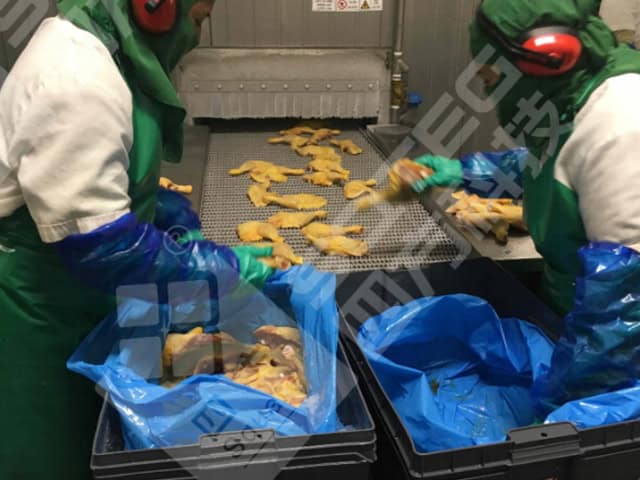
Freezes poultry and meat products efficiently in trays, blocks or packaged formats.

Handles high-moisture pet food, minced formulations and formed blocks for storage and transport.

Freezes sauces, purees and other liquid or semi-liquid products in controlled block formats.
Case Studies
Real production lines with performance data — not renderings, not claims. Each installation documented with commissioning data.
New Square Spiral Freezer and Refrigeration System Grupo Pecuario San Antonio is one of the
No. 25mm thick aluminum plates are automatically welded for structural stability, ensuring minimal deformation and consistent freezing performance, and our one-piece polyurethane foam insulation minimizes cold loss and ensures structural integrity, reducing energy consumption during continuous operation.
Yes. The separate liquid supply and suction design ensures even refrigerant distribution to each plate, providing stable performance even with slight load variations.
We own CE, EAC, INF, CNAS, ISO, ASME, PED, U2, CSA, CRN certifications and 300+ patents, as well as 350+ engineers. Square vertically integrated production ensures quality control from raw materials.
Square offers customized one-stop cold chain solution, and a full range of marine-type plate freezers, compact units with built-in refrigeration, and tailored solutions to fit your processing line or onboard requirements.
Consistent freezing is achieved through flat high-conductivity aluminum plates, balanced refrigerant distribution, correct plate spacing, and stable contact pressure. Square selects the plate size, hydraulic layout, and refrigeration configuration according to the product and loading format.
Engineering Inquiry
Share your product type, target capacity, line layout, utilities, and site conditions. Our engineers will review your requirements and recommend a suitable Plate Freezer configuration.